
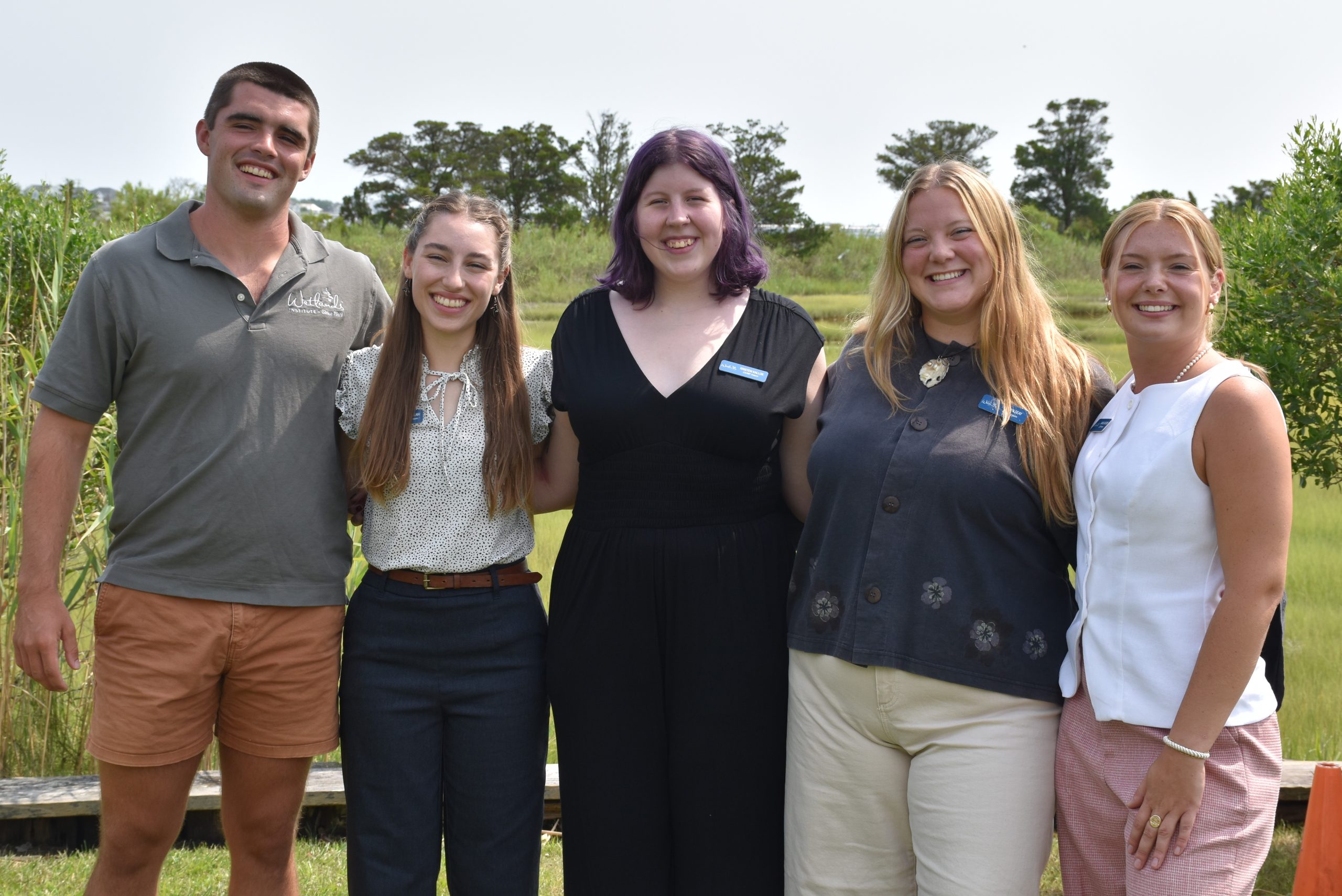
This summer, five Coastal Conservation Research Program interns contributed their passion, energy, and exciting insights to our work. Interns participated in long-term monitoring of Diamondback Terrapins and coastal birds, conducted independent projects that deepened our understanding of coastal wildlife, developed essential skills in the field and lab, and built connections and memories that will last a lifetime. We were particularly fortunate to have two second-year interns to share their experience and expertise with our new arrivals.
Intern Projects Overview
Joey Brace (Florida Gulf Coast University) examined repeat nesting behavior in Diamondback Terrapins at TWI from 2020 to 2025, helping us build a clearer picture of nesting patterns and site fidelity over time.
Mary Castellani (Rutgers University), a second-year intern, explored the foraging patterns of American Oystercatchers on Delaware Bay beaches and Atlantic coastal marshes. She also documented human disturbances at foraging sites, which can help inform restoration planning and disturbance thresholds in key foraging areas during the breeding season.
Sarah Davidson (Widener University) investigated the environmental factors influencing Diamondback Terrapin nest site selection at TWI. Her work supports future efforts to restore, replicate, and protect suitable nesting habitats.
Kristen Kallok (Barnard College of Columbia University) studied the habitat use and home range of eastern box turtles on The Wetlands Institute property. Her project sheds light on how small habitat fragments may contribute to the species’ survival in areas impacted by human development.
Katelyn Seay (Stockton University) analyzed vegetation succession and zonation trends of six focal plant species (Spartina patens, Iva frutescens, Juncus gerardii, Phragmites australis, Baccharis halimifolia, and Distichlis spicataon) on elevated nesting habitat at Ring Island. Her findings offer valuable insight into marsh restoration practices, particularly in determining optimal elevations for vegetation that supports nesting wildlife.